
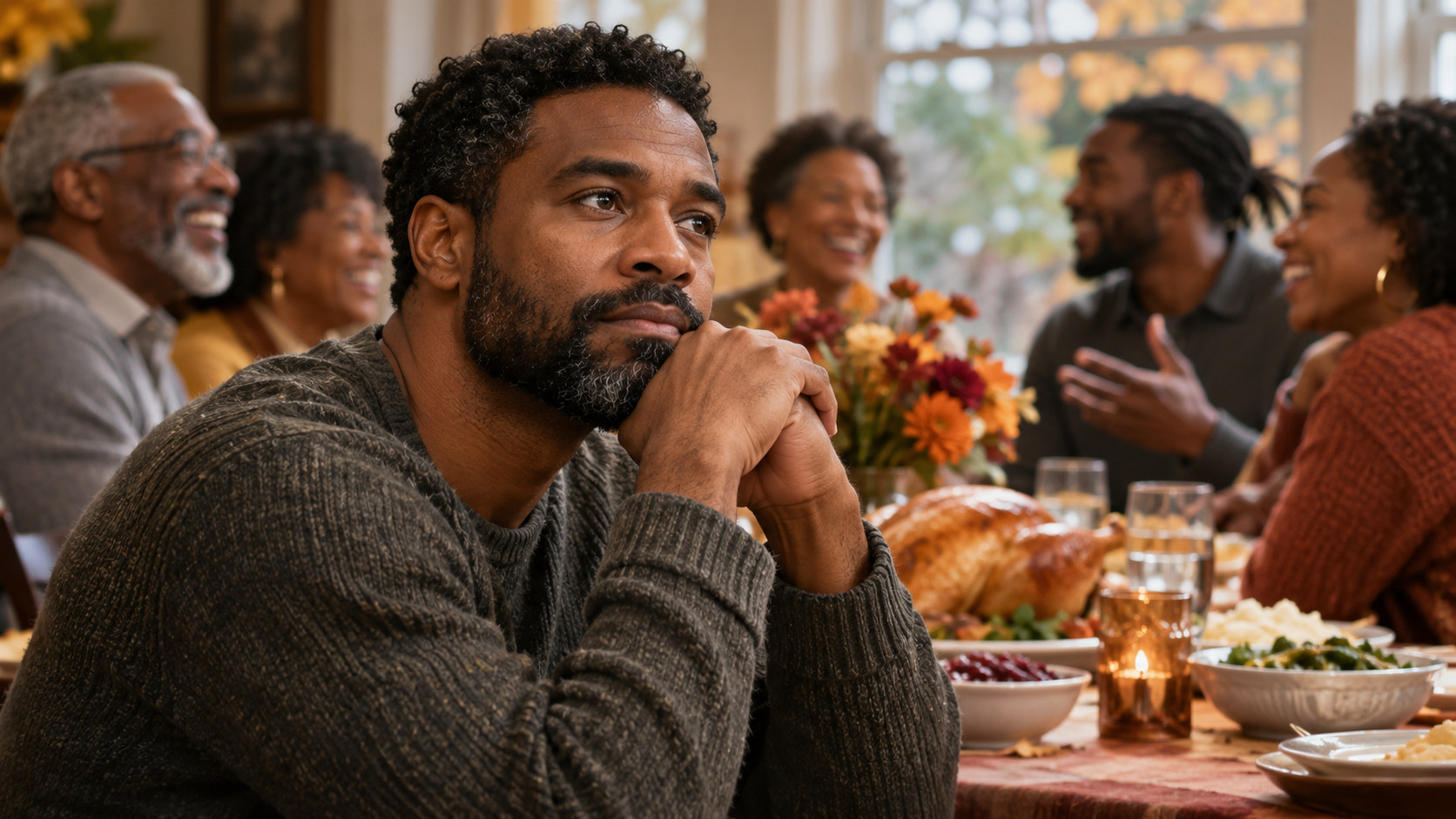

You can spend years becoming your own man, then sit down at a holiday dinner and suddenly feel twelve years old again.
One comment from your father. One familiar look from your mother. A joke from your sibling. A question about your career, your relationship, or why you haven’t visited more often.
And suddenly, something shifts inside you.
Maybe you feel defensive. Irritated. Anxious. Inadequate. Or strangely disconnected from yourself.
You might be a confident, capable adult with a career, relationships, and a life you’ve worked hard to create. Yet somehow, being around certain family members brings back feelings you thought you’d outgrown.
Or perhaps your holidays look completely different.
Maybe you’re spending Thanksgiving alone. Maybe you’ve lost someone you love, become estranged from family, gone through a breakup, or simply realized that the holidays don’t feel the way you wish they did.
Maybe everyone around you seems excited about the season, while you’re just trying to get through it.
Here’s something I want you to consider: What if your difficult feelings around the holidays aren’t signs that something is wrong with you, but invitations to understand yourself more deeply?
As a therapist who specializes in Internal Family Systems (IFS), I believe our emotional reactions can tell us important things about our experiences, our protective patterns, and the parts of ourselves that still need our attention.
And the holidays can provide plenty of opportunities to notice them.
While this article focuses particularly on men’s experiences, the emotional struggles explored here are not exclusive to men. Regardless of your gender identity, if the holidays bring up loneliness, difficult family dynamics, or protective patterns, I hope these reflections help you approach yourself with greater curiosity, compassion, and understanding.
Why the Holidays Can Bring Up So Much Emotion
The holidays are often presented as a season of gratitude, family, joy, and togetherness.
But for many people, the reality is considerably more complicated.
You can love your family and dread spending time with them.
You can feel grateful for your life and still grieve what you’ve lost.
You can enjoy holiday traditions while feeling exhausted by the expectations surrounding them.
And you can be sitting at a table full of people while feeling profoundly alone.
A 2025 American Psychiatric Association survey found that 48% of American adults were concerned about missing someone or experiencing grief during the holidays. Nearly one third were concerned about challenging family dynamics or loneliness.
These experiences are more common than we sometimes imagine.
But there’s another layer worth exploring.
For some men, the holidays don’t simply bring up difficult feelings. They activate long established ways of protecting themselves from those feelings.
And sometimes those protective strategies can leave us feeling even more disconnected.
When Family Gatherings Bring Back Old Versions of Ourselves
Have you ever noticed how differently you behave around certain family members?
Maybe you’re generally comfortable expressing yourself, but around your parents, you become unusually quiet.
Maybe you’re patient in most relationships, yet one comment from a sibling makes you unexpectedly angry.
Maybe you find yourself working hard to keep everyone happy, even though you’ve spent years learning to set boundaries.
From an IFS perspective, these experiences can make a great deal of sense.
Internal Family Systems recognizes that we have different parts of ourselves, each carrying its own emotions, beliefs, memories, and protective intentions.
Some of these parts developed their strategies when we were very young.
Perhaps you learned that expressing anger would get you punished.
Maybe showing sadness led to ridicule or dismissal.
Maybe affection felt conditional, so you became exceptionally good at achieving, pleasing others, or avoiding conflict.
These strategies may have helped you navigate your family environment.
And even though you’re now an adult, being around familiar people and situations may activate those same protective responses.
Sometimes the people who have known us the longest are the people around whom we find it hardest to be our authentic selves.
That doesn’t necessarily mean your family members are intentionally doing anything harmful today. It means your history with them may influence how you experience the present.
And recognizing that difference can be incredibly valuable.
The Pressure Men May Feel to Be Strong, Helpful, and Okay
Many men grow up receiving messages about what it means to be a good man.
Be strong.
Take care of your family.
Don’t complain.
Keep your emotions under control.
Be the dependable one.
There can be real value in responsibility, resilience, and caring for others.
But what happens when these qualities become expectations you feel you can never step outside?
During the holidays, some men find themselves carrying an enormous amount of responsibility.
Maybe you’re managing family finances, hosting relatives, navigating conflict, taking care of children, or trying to ensure everyone else has a good experience.
Perhaps you’re also carrying private struggles that nobody knows about.
You’re anxious about money.
You’re grieving a relationship.
You’re overwhelmed at work.
You’re questioning your direction in life.
You’re feeling disconnected from your partner.
Or maybe you’re simply exhausted from being the person everyone depends on.
Yet when someone asks how you’re doing, your automatic response is:
“I’m good.”
And the conversation moves on.
But who takes care of the man who’s always taking care of everyone else?
I’m not suggesting that all men experience masculinity this way. Many men have loving, emotionally supportive relationships and feel comfortable seeking help.
But for men who have learned to equate vulnerability with weakness, the holidays can reinforce a painful pattern of appearing fine while struggling privately.
The result can be a particularly confusing kind of loneliness.
Why You Can Feel Lonely Even When Surrounded by Family
One of the most painful experiences isn’t necessarily being alone.
It’s feeling alone in the presence of people you wish you could connect with.
You might spend Thanksgiving surrounded by relatives, sharing food, stories, and laughter, while realizing that nobody really knows what’s happening inside you.
Perhaps they know your accomplishments, your responsibilities, your opinions, and your role in the family.
But do they know your fears?
Your disappointments?
Your deepest hopes?
The things you’re still trying to understand about yourself?
Sometimes, family relationships contain years of familiarity without the emotional intimacy we long for.
And sometimes we contribute to that distance by protecting ourselves from being seen.
In my previous article about male loneliness, I explored how men can have plenty of social interaction while still longing for the experience of being genuinely known.
The holidays can make that longing especially noticeable.
Not because every family gathering should involve deep emotional conversations, but because these occasions can remind us of the difference between the relationships we have and the relationships we wish we had.
Understanding Your Holiday Triggers Through IFS
One of the things I appreciate most about Internal Family Systems is that it helps us understand our internal experiences without automatically judging or fighting them.
Imagine you’re visiting family for Thanksgiving.
A relative makes a comment about your parenting, your appearance, or a personal decision.
Almost immediately, you feel something happening inside.
One part of you becomes angry and wants to confront them.
Another part wants to keep the peace.
Another feels hurt or ashamed.
Another wants to withdraw, scroll through your phone, or leave entirely.
And perhaps another part criticizes you for getting so upset in the first place.
These different responses may feel contradictory.
But from an IFS perspective, we can become curious about what each part is trying to accomplish.
Maybe your angry part wants to protect you from being disrespected.
Your people pleasing part wants to prevent conflict or rejection.
Your withdrawing part wants to keep you emotionally safe.
And your self critical part believes that if it can control your behavior, you might avoid embarrassment or judgment.
What if, instead of fighting these parts, you became curious about what they’re trying to protect?
This doesn’t mean every emotional reaction should be followed or acted upon.
It means we can learn to respond to our reactions with greater awareness rather than automatically becoming overwhelmed by them.
And that awareness can create more opportunities to choose how we want to respond.
You Don’t Have to Force Yourself to Feel Grateful
Thanksgiving is often associated with gratitude.
And gratitude can be a meaningful practice.
But gratitude shouldn’t require us to deny grief, anger, disappointment, loneliness, or other difficult emotions.
You can appreciate the good things in your life while acknowledging what hurts.
You can love certain family members while recognizing that some relationships feel unsafe or emotionally draining.
You can be thankful for what you have while longing for something different.
And you can choose not to celebrate a holiday that doesn’t align with your values or experiences.
Thanksgiving itself carries different meanings for different people. For some, it represents connection and gratitude. For others, including Indigenous people who observe the National Day of Mourning, it is also connected with colonization, historical loss, and an incomplete national narrative. The National Museum of the American Indian offers important perspectives on this history.
Whatever the holiday represents to you, there’s no requirement to manufacture a particular emotional experience.
Authenticity doesn’t mean choosing gratitude over pain. Sometimes it means making room for both.
Five Ways to Care for Yourself During Difficult Holiday Experiences
1. Check in with yourself before you check in with everyone else
Before entering a family gathering or holiday event, take a few quiet moments to notice what’s happening inside you.
Ask yourself:
“What am I feeling about this experience?”
“What parts of me are looking forward to it?”
“What parts of me are feeling anxious, resistant, or overwhelmed?”
“What might I need to feel more supported?”
You don’t need to change how you feel.
Begin by listening.
2. Get curious about your emotional reactions
If someone says or does something that triggers a strong response, see if you can pause before reacting.
Notice what’s happening in your body.
Perhaps your chest tightens, your jaw clenches, or you suddenly feel an urge to defend yourself.
Instead of immediately criticizing your reaction, consider asking:
“What part of me is feeling activated right now?”
“What is this part afraid might happen?”
“How might I support this part without letting it make every decision for me?”
Even a few moments of compassionate curiosity can create space for a more intentional response.
3. Give yourself permission to have boundaries
You are allowed to decide which conversations you participate in, how long you stay at gatherings, and what kinds of interactions you’re willing to tolerate.
A boundary might sound like:
“I’d rather not discuss that today.”
“I’m going to step outside for a few minutes.”
“I appreciate your concern, but I’m comfortable with my decision.”
Or simply:
“I’m not available for that conversation.”
Setting boundaries doesn’t require you to prove that someone else is wrong.
And if a relationship is genuinely unsafe, protecting yourself may involve limiting contact or choosing not to participate.
Your emotional well being matters, too.
4. Reach out to someone who helps you feel genuinely connected
If the holidays bring up loneliness, consider whether there’s someone you trust with whom you could share some of your experience.
A friend. A partner. A sibling. A therapist. Someone in your community.
You don’t necessarily need advice or solutions.
Sometimes being able to say, “The holidays have been harder than I expected,” and having someone respond with genuine care can be meaningful.
You also don’t need to wait for someone else to initiate.
Connection sometimes begins with the courage to reach out.
5. Create holiday experiences that actually align with your needs
You don’t have to participate in every tradition simply because it’s familiar.
Maybe you want a quieter Thanksgiving.
Maybe you want to spend time with chosen family or close friends.
Maybe you need time alone, a walk in nature, or an opportunity to remember someone you’ve lost.
Maybe you want to create entirely new traditions.
Ask yourself:
“If I wasn’t trying to meet everyone else’s expectations, what would I actually want this holiday season to feel like?”
Your answer might reveal something important about your needs, values, and desires.
What If the Holidays Became an Opportunity for Greater Self Understanding?
I don’t believe the goal of emotional growth is to reach a place where nothing ever triggers us.
We are human beings with histories, relationships, vulnerabilities, and protective responses.
Of course certain experiences will affect us.
But imagine approaching this holiday season differently.
Instead of judging yourself for feeling anxious around family, you become curious about the parts that feel unsafe.
Instead of criticizing yourself for wanting to withdraw, you explore what that part might need.
Instead of automatically taking responsibility for everyone else’s happiness, you begin recognizing your own needs.
And instead of expecting yourself to be the strong one all the time, you consider what it might feel like to receive support.
These experiences don’t necessarily make the holidays easy.
But they can become opportunities for greater self compassion, authenticity, and choice.
And perhaps most importantly, they can help us recognize that we don’t need to continue navigating life entirely on our own.
Men Need Places Where They Don’t Have to Pretend They’re Okay
There’s something I’ve come to value deeply in my work facilitating men’s therapy groups.
Men need opportunities to connect beyond the roles they carry in everyday life.
Places where they don’t have to be the provider, the problem solver, the successful professional, or the person who always has everything figured out.
Places where they can explore difficult emotions, question old beliefs, develop healthier relationships, and discover that other men may be navigating struggles similar to their own.
For some men, simply having the opportunity to be honest about their experiences with other men can be unfamiliar.
And potentially very meaningful.
An ongoing therapy group provides a structured environment where men can develop self understanding, practice authentic connection, and explore relationship patterns with the support of a trained facilitator.
It’s not about forcing vulnerability or expecting everyone to share everything.
It’s about gradually creating opportunities for meaningful connection, with curiosity, consent, and respect for each person’s boundaries.
And these opportunities don’t have to end when the holidays are over.
You Deserve Connection That Lasts Beyond the Holidays
Maybe this holiday season will be joyful.
Maybe it will be complicated.
Maybe you’ll experience moments of gratitude alongside moments of grief, frustration, or loneliness.
Whatever arises, I hope you’ll consider approaching yourself with a little more curiosity and compassion.
You don’t need to be perfectly regulated, emotionally available, or completely healed to deserve meaningful relationships.
You don’t need to abandon your strength to acknowledge that sometimes you need support.
And you don’t have to keep pretending you’re okay when you aren’t.
As a Certified Internal Family Systems Therapist and experienced men’s group facilitator, I offer Healing Through Connection, an ongoing online men’s therapy group for men in California and Washington.
It’s a space to explore your inner world, develop greater self compassion, strengthen your relationships, and experience meaningful connection with other men.
The group meets weekly for 90 minutes and costs $300 per month (sliding scale spots are currently available). I offer a free 15 minute consultation to help you explore whether it’s a good fit.
If you’ve been longing for deeper friendships, more authentic relationships, or a place where you can be more fully yourself, I invite you to consider joining us.
Learn More About My Online Men’s Therapy Group and Schedule a Free Consultation
You may not be able to change the family or experiences that shaped you, but you can begin creating a life where you no longer have to hide the parts of yourself that most need to be seen, understood, and loved.
In compassionate support,
Forest Benedict, LMFT
Certified IFS Therapist
Licensed in Washington & California
Leave a Reply