
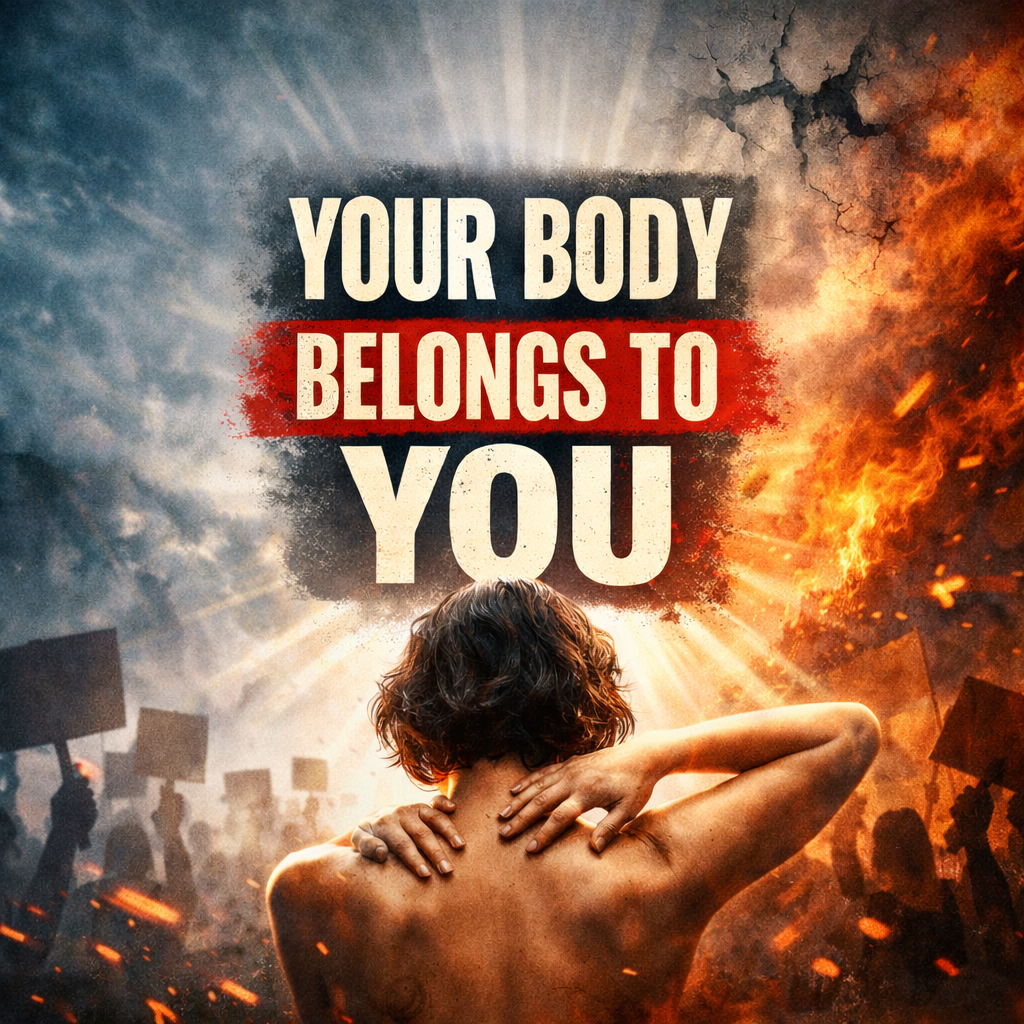

Your body is not a debate.
It is not a moral project.
It is not public property.
Your body belongs to you.
Yet many of us live as if it doesn’t.
From the moment we are born, forces outside of us begin shaping how we are “allowed” to inhabit our bodies—religion, culture, family systems, advertising, gender norms, productivity culture, and relationship expectations. Often, these narratives are placed on us without our consent, which is itself a violation of body autonomy.
This is not neutral.
This is not harmless.
And it is not something we simply “think our way out of.”
What Body Autonomy Actually Means (and Why It’s So Threatening)
Body autonomy means you are the ultimate authority over your body—your sensations, your boundaries, your expression, your pleasure, your rest, your movement, your sexuality.
No religion has the right to your body.
No authority has the right to control it.
No partner, parent, system, or institution gets to decide what you should do with it.
Not even culture, beauty standards, or advertising.
And yet, many of these forces try.
They tell us:
- How our bodies should look
- How much space they should take
- When they are “too much” or “not enough”
- Who they are for
- How they should be used, restrained, perfected, or submitted
Learning body autonomy is not just personal growth, it’s psychological liberation.
The Cost of Living in a Body That Isn’t Yours
When body autonomy is compromised, we often experience:
- Chronic shame or self-policing
- Difficulty saying no (or even knowing what no feels like)
- Dissociation from sensation and desire
- Confusion around consent, pleasure, or boundaries
- A sense of being “cut off” from ourselves
Many clients I work with don’t realize how deeply external narratives are still guiding their decisions—until we slow down enough to listen to the body itself.
This is where therapy and education meet.
How IFS Helps Untangle Shame and Reclaim Choice
One of the primary modalities I use with clients is Internal Family Systems (IFS).
IFS is powerful because it helps people:
- Identify internalized voices of control, shame, and fear
- Understand where those narratives came from
- Release roles that were formed for survival, not truth
- Create space to choose—for themselves—who they are and who they want to be
Instead of battling the body or forcing change, IFS offers a fresh starting point: a compassionate relationship with the parts of you that learned to submit, hide, comply, or disconnect in order to stay safe.
From there, real autonomy becomes possible.
Why Education Is a Form of Consent
True consent requires information, choice, and embodied awareness.
Yet many people were never taught:
- How to listen to their body
- How to feel desire without shame
- How to explore safely and intentionally
- How to express themselves sexually, socially, or relationally in ways that feel aligned
This is why education matters—not as instruction on who to be, but as permission to explore.
One resource I often recommend for adults who want to learn about body autonomy, embodiment, and empowered self-expression is Beducated (affiliate link).
Beducated as a Resource for Reclaiming Your Body
Beducated is an online education platform where adults can learn new ways to explore and express their bodies—sexually, relationally, and socially—without shame, coercion, or rigid scripts.
What I appreciate about Beducated is that it:
- Centers consent, curiosity, and self-directed learning
- Encourages embodiment rather than performance
- Challenges dominant narratives about sexuality and bodies
- Supports confidence, agency, and self-expression
Rather than controlling or submitting our bodies to the dominant narratives of others, Beducated invites us to become informed participants in our own lives.
If you’re looking for a supportive, educational space to learn about your body and what it’s capable of—at your own pace—you can explore it here:
Transparency note: This is an affiliate link. I only recommend resources that align with ethical and autonomy-centered values.
Body Autonomy Is a Practice, Not a Personality Trait
Reclaiming your body is not about rebellion for rebellion’s sake.
It’s about choice.
It’s about noticing where you’ve been living under rules you never agreed to and deciding what still fits.
Some people fight oppressive systems outwardly.
Others do it quietly, inwardly, by listening to their bodies for the first time.
Both matter.
A Final Truth to Sit With
Your body is not something to conquer, fix, or hand over for approval.
It is something to know.
When we educate ourselves about our bodies, explore our desires, question inherited narratives, and practice embodied consent, we begin to access a deeper power—one rooted in self-trust.
You are more powerful than you think.
More capable than you were taught.
And far more entitled to your own body than any system would have you believe.
Your body belongs to you.
In empowering support,
Forest Benedict, LMFT
Certified IFS Therapist, Sex & Desire Coach
For more articles and poems on sexuality, shame, desire, self-connection, Internal Family Systems (IFS), religious trauma, CPTSD, codependency, healing, and embodied transformation, I invite you to explore my blog and follow along for future posts.
Transparency note: This post contains an affiliate link. If you choose to explore Beducated through this link, I may earn a small commission at no additional cost to you. I only share resources I genuinely respect and believe can be supportive for people exploring sexual learning.


Leave a Reply